


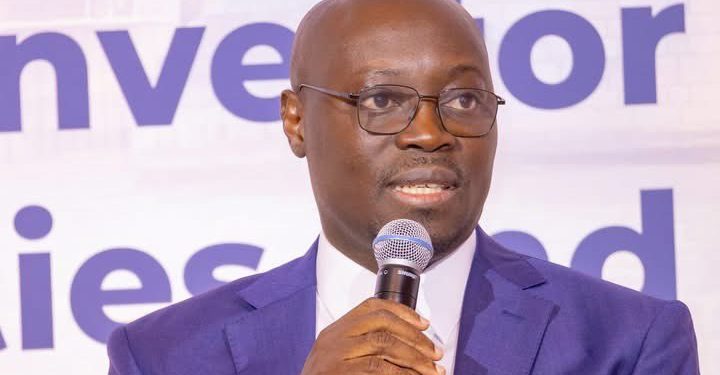
Finance Minister Dr. Cassiel Ato Forson has raised concerns over the growing practice of mining companies renewing leases and subsequently transferring or selling the assets, warning that such arrangements may no longer be treated as routine under Ghana’s evolving mining policy framework.
His comments come as government prepares to take a decision on the future of the Tarkwa Mine before the end of the year, one of the country’s most strategic gold assets currently nearing the end of its lease cycle.
Speaking in an interview with Bloomberg, Dr. Forson referenced a recent transaction involving Newmont, where a renewed mining lease was reportedly sold for about one billion dollars shortly after extension.
“We renewed it; the following month they sold it for a billion dollars and only paid capital gains after the state,” he said.
While acknowledging that government collected its due revenues from the transaction, he questioned the policy implications of such practices going forward.
“You can’t just renew your lease and sell it the following month. The intention out there was for us to renew the lease for them to continue in business,” he added.
Dr. Forson stressed that although Ghana remains committed to attracting mining investment, lease renewals are intended to support continued production rather than create secondary markets for asset flipping.
The remarks come at a time when government is engaged in delicate discussions over the future of the Tarkwa Mine, which was originally state-owned before being leased to a foreign operator for a 30-year period.
Under the terms of the agreement, the asset is expected to revert to the state upon expiry, although discussions are ongoing over whether the lease should be extended or returned to state control.
“There is a conversation around whether we revert it back to the State Mining Company or allow the company to extend the lease,” he noted, adding that government expects to conclude the matter before year-end.
“As I said, we have up to April next year, almost one year .And our intention is to have that conversation to the end of the year. And so before 2026, we’ll have some agreement.”
Beyond ownership questions, Dr. Forson also defended ongoing mining reforms, including a sliding-scale royalty regime designed to increase state revenue during periods of high gold prices.
He explained that the mechanism ensures Ghana captures additional economic rent when global prices rise significantly, rather than relying on fixed royalty rates that may undervalue windfall gains.
“We introduced the sliding scale to be able to capture the economic rent,” he said.
The Finance Minister maintained that the reforms are already in effect and were developed in consultation with industry players, forming part of broader efforts to reposition Ghana’s mining sector for long-term value retention.


