


In the warm glow of a Hungarian evening on May 30, 2026, at Budapest’s iconic Puskás Aréna, Arsenal Football Club experienced the cruelest twist of fate yet in their long and often heartbreaking quest for European glory.
The Gunners, who had stormed through the 2025/26 season as Premier League champions and navigated a treacherous path to their first Champions League final in two decades, fell just short against the defending champions Paris Saint-Germain.
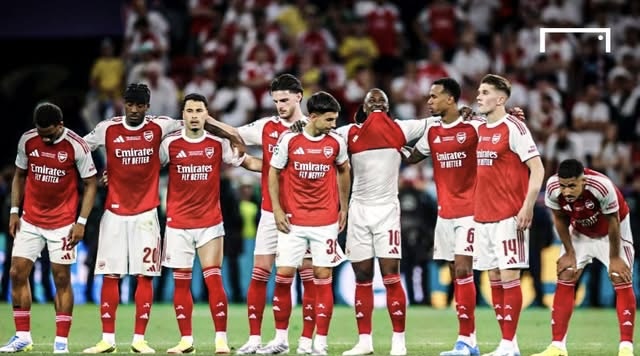
What unfolded was a tense, tightly contested battle that ended in a 1-1 draw after extra time, only for PSG to prevail 4-3 in a dramatic penalty shootout, securing back-to-back titles and leaving Arsenal’s players and supporters devastated on the grandest stage.
This was no ordinary final. For Arsenal, it represented a monumental milestone—their second appearance in the Champions League showpiece, coming exactly 20 years after that agonizing night in Paris in 2006 when they were edged out by Barcelona.
Under the astute guidance of Mikel Arteta, the North London side had transformed from perennial nearly-men into genuine European contenders, blending youthful exuberance with hardened experience. Reaching the final itself was a triumph of resilience, tactical evolution, and collective belief, especially after overcoming formidable opponents en route, including a gritty semi-final victory over Atlético Madrid.
Yet on this night in Budapest, destiny favored the French powerhouse, who arrived as holders and demonstrated why they remain the benchmark in continental football.
The match began with Arsenal seizing the initiative in electrifying fashion. Just five minutes in, Kai Havertz, the German forward whose big-game pedigree had been questioned by some, rose to the occasion with a clinical finish that sent the sea of red and white supporters into raptures.
It was a goal born of Arsenal’s high-pressing intensity and quick transitions, the kind of proactive football that had defined their campaign. For a moment, it felt as though the ghosts of 2006 might finally be exorcised, with the Emirates faithful back home and in the stands dreaming of lifting the iconic trophy for the first time in the club’s history.
PSG, marshaled by the experienced Luis Enrique, looked momentarily stunned, their usual fluidity disrupted by Arsenal’s compact shape and midfield control led by Declan Rice and the emerging academy talent Lewis-Skelly.
As the first half wore on, however, the defending champions regrouped. Ousmane Dembélé, ever the mercurial threat on the wing, began to find pockets of space, his pace and trickery posing constant problems for Arsenal’s backline featuring William Saliba and Gabriel.
The game settled into a tactical chess match, with both sides trading half-chances but neither able to find a second goal before the interval. Extra time loomed as a real possibility, and the tension in the Puskás Aréna was palpable, the crowd—a vibrant mix of traveling English and French fans—creating an atmosphere that lived up to the occasion’s billing.
The equalizer arrived midway through the second half from the penalty spot. A controversial decision led to Ousmane Dembélé stepping up and calmly converting, restoring parity and shifting the momentum firmly toward PSG.
Arsenal’s response was admirable; they pushed forward with renewed vigor, introducing fresh legs in search of a winner, but the French side’s defensive organization and the heroics of their goalkeeper held firm. Into extra time the contest went, where fatigue began to play its part. Legs grew heavy, passes went astray, and both teams flirted with opportunities that ultimately fizzled out. It was a classic final defined by fine margins, where one slip could decide everything.
With the score locked at 1-1, the drama reached its crescendo in the penalty shootout. Arsenal’s takers showed nerves of steel initially, but in the end, misses from key players including Eberechi Eze and Gabriel proved decisive. PSG converted with clinical efficiency, their composure under pressure underscoring their status as serial winners.
Vitinha was later named man of the match for his midfield masterclass, embodying the balance that carried his team through. As the final whistle blew on the shootout, PSG players erupted in celebration, hoisting the trophy aloft for the second successive year—a feat that cements their place among Europe’s elite in the modern era. For Arsenal, the pain was immediate and profound.
Mikel Arteta, ever the picture of dignity in defeat, faced the media with a mix of pride and raw emotion. He spoke of the immense progress his squad had made, calling them the best team in the world in his eyes despite the outcome, and urged supporters to recognize the journey rather than dwell solely on the destination. “It’s only the second time in our history that we’ve done it,” he reflected, acknowledging the rarity of Arsenal’s deep run while vowing that this heartbreak would fuel future ambitions.
Players like Bukayo Saka, who had been instrumental throughout the campaign, and captain Martin Ødegaard wore the disappointment visibly, yet their heads remained high, knowing they had given everything on a night when the margins were razor-thin.
In the broader context, Arsenal’s run to the final marked a significant chapter in their revival. Twenty years on from the 2006 disappointment, they had returned to the pinnacle with a squad brimming with talent, depth, and character.
The Premier League title won earlier the season provided silverware and momentum, but the Champions League remains the ultimate prize—one that continues to elude them. PSG, meanwhile, joined an exclusive club as back-to-back winners, their project under Qatari ownership finally delivering consistent European dominance after years of near-misses.
The streets of Budapest echoed with contrasting emotions that night: jubilation for the Parisians, who partied long into the early hours, and quiet reflection mixed with pride for the Arsenal faithful, many of whom had journeyed across continents in hope of glory.
For Arsenal, the wait for that elusive Champions League crown extends further, but the foundation laid in 2025/26 suggests brighter nights ahead. In football, as in life, the pain of defeat often sharpens the hunger for victory, and this chapter, though ending in tears in Budapest, may yet prove the catalyst for future triumphs on the European stage. The Gunners’ odyssey continues, resilient as ever.


