


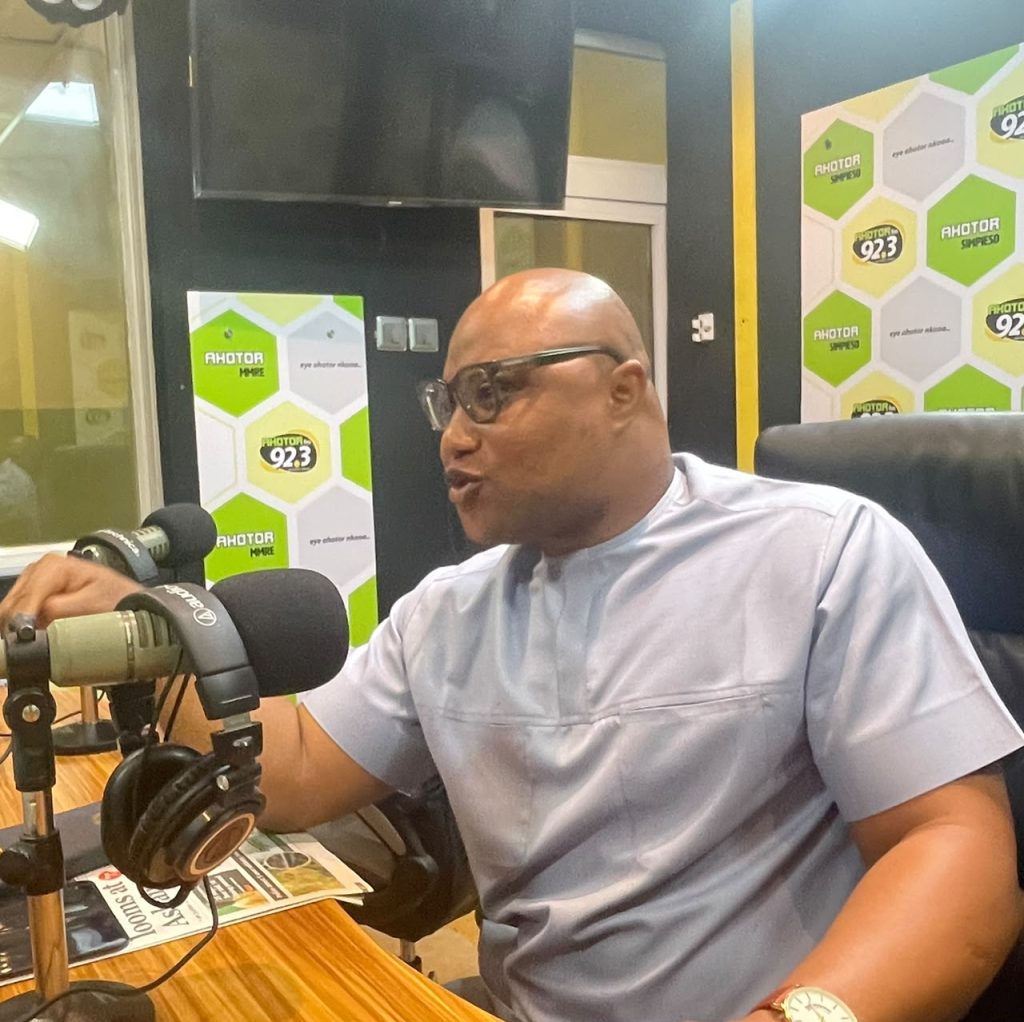
Owura Amos Musi Blessing, an aspiring Greater Accra Regional Secretary of the National Democratic Congress (NDC), has defended the government and GoldBod in the ongoing controversy over the reported GH¢1.7 billion loss, while stressing that the Minority in Parliament has a legitimate responsibility to hold government accountable.
Speaking on Ahotor FM’s Adekyee Mu Nsem programme on Tuesday, August 25, 2026, in Accra, Owura Amos Musi Blessing said democracy requires both a majority and a minority, with the Minority expected to scrutinise the government and ensure that public officers are held accountable.
He said no public officer should consider himself beyond reproach while in office or even after leaving office.
According to him, the Minority Leader, Alexander Afenyo-Markin, has in recent times embarked on what he described as a spirited agenda to hold the government accountable, saying such scrutiny is healthy for democracy because it keeps government on its toes to deliver on its mandate.
Mr. Musi Blessing, however, cautioned that the exercise must be based on accurate facts.
He said the controversy surrounding GoldBod and the Bank of Ghana is largely about who should bear the liability for the reported GH¢1.7 billion loss.
He explained that there is an acknowledgement that the loss exists, with Sammy Gyamfi himself admitting at a press conference that there was a GH¢1.7 billion loss.
The disagreement, he said, is whether the liability belongs to GoldBod or the Bank of Ghana.
Mr. Musi Blessing argued that such losses are not necessarily the result of incompetence, explaining that foreign exchange differentials can create losses when transactions involve gold and fluctuating exchange rates.
He said the exchange rate at which gold is purchased may differ from the rate applied by the Bank of Ghana, commercial banks and other participants in the transaction.
“Exchange rates, it’s not stable. It fluctuates. Because this morning, the amount you change your dollar, when you go to the same market in the evening, it will change,” he said.
According to him, because gold is traded using foreign exchange, differences in exchange rates can result in losses when accounts are eventually reconciled and closing balances are calculated.
He said similar losses have occurred in previous years, including under the Gold-for-Oil arrangement introduced during the previous administration.
Mr. Musi Blessing stressed that the existence of such a loss should therefore not automatically be interpreted as evidence that someone was incompetent.
He said much of the current controversy stems from two lines in the IMF report, specifically page 30, paragraph 59.
According to him, the report acknowledges the GH¢1.7 billion loss but recommends that going forward, the liability should not remain on the books of the Bank of Ghana but should instead be recorded in the books of GoldBod.
He explained that such a recommendation is intended to guide future operations and prevent similar issues from recurring.
Mr. Musi Blessing compared the recommendation to reports issued by Ghana’s Auditor-General, where institutions are given recommendations to correct weaknesses and prevent their recurrence.
He stressed that an IMF recommendation does not automatically become binding on the Bank of Ghana.
He said the Bank of Ghana has the discretion to decide whether to adopt the recommendation, particularly as Ghana is now close to exiting the IMF programme.
He therefore maintained that when Sammy Gyamfi says GoldBod has not incurred the GH¢1.7 billion loss, he is speaking to what is currently reflected in the accounting arrangement.
According to him, the IMF report indicates that the liability is currently sitting in the books of the Bank of Ghana and not GoldBod.
Mr. Musi Blessing consequently questioned why the Minority Leader would insist on attributing the GH¢1.7 billion loss to GoldBod despite the contents of the report.
He suggested that Sammy Gyamfi may have become a particular target because of the prominent role he played in the NDC’s 2024 election campaign.
He said political opponents may be attempting to use the GoldBod controversy to target the Minister and that this has contributed to the repeated press conferences and public debate surrounding the issue.
Extortion Allegations
Mr. Musi Blessing also addressed the separate allegations of extortion involving Sammy Gyamfi and the Minority Leader, saying some people have taken Sammy Gyamfi’s comments out of context.
He explained that, based on the Joy FM interview and the subsequent letter issued by Mr. Afenyo-Markin, Sammy Gyamfi did not explicitly describe the Minority Leader as an extortionist.
He said Sammy Gyamfi’s comments were made in the context of a question about whether Mr. Afenyo-Markin had previously called somebody an extortionist during his appearances on Newsfile.
Mr. Musi Blessing said there is a distinction between explicitly calling someone an extortionist and making a statement that could be interpreted by implication to mean that.
He further rejected claims that Sammy Gyamfi had admitted paying money to Mr. Afenyo-Markin after the latter demanded it.
According to him, Sammy Gyamfi has never publicly stated that Mr. Afenyo-Markin demanded money from him and that he subsequently gave him the money.
He said there is therefore a need for the actual facts to be established rather than relying on assumptions.
Mr. Musi Blessing welcomed the decision by Mr. Afenyo-Markin to pursue the matter through the courts and noted that other individuals have also petitioned investigative agencies.
He said such investigations would help establish exactly what happened and whether any offence was committed.
He also addressed questions about why Sammy Gyamfi allegedly waited before reporting the matter to the police.
Mr. Musi Blessing said the public does not have sufficient details about when the alleged incident occurred.
He therefore questioned how anyone could conclusively say Sammy Gyamfi deliberately delayed reporting the matter when the exact date and circumstances of the alleged incident had not been made public.
He said the alleged incident could have happened recently or much earlier, and until the details are provided, the public cannot determine whether there was an unreasonable delay.
He further argued that even if, for the sake of argument, the alleged incident happened one or two years ago, that alone would not prevent an investigation.
According to him, a criminal allegation does not simply disappear because time has passed.
Mr. Musi Blessing said if a crime is alleged to have been committed, it can still be investigated even years later, depending on the circumstances and applicable law.
He therefore urged the public to allow the appropriate institutions to investigate the allegations rather than drawing conclusions based on political arguments.
He maintained that political accountability is important in every democracy, but insisted that accountability must be based on evidence, facts and proper interpretation of official reports.
Story by Stephen Kwaku Owusu Mintah
Ahotoronline, Accra


