


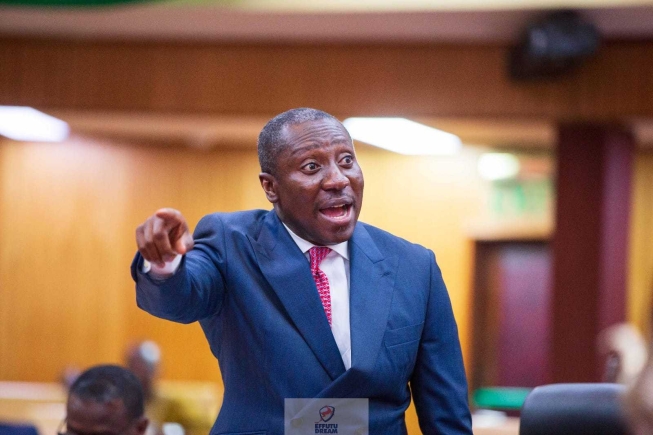
ACCRA — Alexander Kwamena Afenyo-Markin’s elevation to Minority Leader of the New Patriotic Party (NPP) Caucus in Ghana’s Ninth Parliament places him in an unusual but potentially advantageous position: he is leading the opposition after having spent the closing months of the previous Parliament as Majority Leader. The NPP formally retained him for the Minority leadership when the Ninth Parliament began in January 2025.
For Afenyo-Markin, therefore, the challenge is not learning Parliament. It is redefining himself from a government defender into a credible alternative national leader.
The Effutu MP is a long-serving parliamentarian, having served in the Sixth, Seventh and Eighth Parliaments, and Parliament’s official profile lists him as ranking member on the Appointments and Business Committees. His experience gives him an institutional advantage that many opposition leaders do not possess: he knows the workings of government from the inside.
The strength: parliamentary experience
Afenyo-Markin’s principal asset is his command of parliamentary procedure and political argument.
Having served as Deputy Majority Leader and subsequently Majority Leader, he understands the machinery of government business, negotiations between the two sides of the House, committee work and the political calculations behind parliamentary scheduling. That experience can make him a formidable opposition leader.
His task now is to turn that experience into effective scrutiny rather than simply partisan resistance.
That distinction matters.
A Minority Leader who merely attacks government may energise his party’s base. A Minority Leader who can dissect a policy, identify its weaknesses and then offer a workable alternative begins to look like a Prime Minister-in-waiting or government-in-waiting.
The immediate test: discipline within his own ranks
Interestingly, one of Afenyo-Markin’s own public concerns has been internal cohesion.
In November 2025, he warned the NPP Minority Caucus that internal divisions were weakening its ability to hold the government accountable, arguing that disunity within the caucus represented a serious threat to its parliamentary effectiveness.
That may be one of the most important tests of his leadership.
The Minority Leader cannot effectively scrutinise the Majority if his own caucus is divided, undisciplined or speaking with multiple voices.
His leadership therefore requires three things simultaneously:
discipline, delegation and consultation.
The Minority Leader should not have to be the NPP’s spokesman on every subject. A sophisticated opposition should have strong sectoral voices capable of mastering the economy, health, education, energy, agriculture, security and foreign affairs.
From criticism to alternative policy
Afenyo-Markin’s recent interventions show that he has adopted an assertive opposition posture. In July 2026, for example, he criticised the government’s 2026 mid-year budget review as “uninspiring” and “hopeless.”
That is legitimate opposition politics.
But the larger political question is:
What is Afenyo-Markin’s alternative?
This is where his leadership will ultimately be judged.
The public will expect more than criticism of the Mahama administration. They will increasingly ask the NPP Minority:
- What would you do about the economy?
- What is your alternative fiscal strategy?
- How would you create jobs?
- How would you manage public debt?
- What is your alternative to government’s major social programmes?
- What would you do differently in education and health?
- How would you reform public administration?
- What lessons has the NPP itself learnt from its time in office?
A credible Minority Leader must be able to answer these questions before an election campaign begins.
The political opportunity
There is another dimension to Afenyo-Markin’s position.
Because he has occupied a senior government leadership position so recently, he is uniquely placed to explain to the public how government actually works.
That gives him an opportunity to become an unusually effective watchdog.
He can scrutinise the government not merely from the perspective of an opposition politician, but from the perspective of someone who understands Cabinet priorities, parliamentary procedure, government budgeting and the practical difficulties of implementing policy.
Used properly, that experience could make his opposition more substantive.
But there is a danger
The danger is that Afenyo-Markin remains trapped in the style of a Majority Leader campaigning from the opposition benches.
The two offices demand different political instincts.
A Majority Leader’s instinct is:
How do I get government business through Parliament?
A Minority Leader’s instinct must be:
How do I test government business, protect Parliament and present a better alternative?
That transition is crucial.
The strongest opposition leaders internationally are not necessarily those who speak the loudest. They are those who make government explain itself, force ministers to defend their decisions and demonstrate that the opposition possesses the competence to govern.
Beyond Parliament
Afenyo-Markin’s bigger challenge may actually lie outside the Chamber.
The NPP needs rebuilding after its 2024 electoral defeat, and the Minority Leader has a role that goes beyond parliamentary combat. He must connect Parliament with the wider public and help rebuild confidence in the NPP’s capacity to govern.
That requires engagement with:
- business and industry;
- organised labour;
- professional bodies;
- academia;
- civil society;
- young people;
- religious and traditional leaders;
- regional constituencies; and
- ordinary voters.
His role should increasingly resemble a national listening post for the opposition.
The NPP cannot simply wait until 2028 and then produce a manifesto. Its alternative government must be developed continuously.
The 2028 question already hangs over the office
Afenyo-Markin’s performance will inevitably be assessed against the NPP’s larger political comeback.
Indeed, in February 2026, NPP National Organiser Henry Nana Boakye publicly rejected calls for Afenyo-Markin’s removal and described him as a strong and effective Minority Leader.
That endorsement suggests that, at least at the party’s national-organisational level, there remains confidence in his leadership.
But confidence within the party is only one measure.
The harder test is public confidence outside the NPP.
Can Afenyo-Markin persuade floating voters, young voters, professionals and citizens who are not committed to either major party that the NPP has learnt from its previous administration and is developing a credible governing alternative?
That is a much higher bar.
The statesman test
There is also a constitutional dimension.
A good Minority Leader should defend the NPP vigorously without weakening Parliament itself. He must be prepared to oppose government when necessary, cooperate when the national interest requires it, and defend parliamentary institutions even when doing so does not immediately benefit his party.
His recent involvement in the ECOWAS Parliament controversy also illustrates the increasingly broad institutional arena in which his leadership operates. Parliament moved in June 2026 to reconstitute Ghana’s delegation to the ECOWAS Parliament, including Afenyo-Markin, following a dispute over his continued participation in the regional legislature.
Such episodes reinforce a broader point: the Minority Leader is not merely an NPP political operative; he is also a constitutional actor.
Verdict
Afenyo-Markin enters the Minority leadership with something rare: experience on both sides of the parliamentary divide.
His strengths are evident — parliamentary experience, legal training, political communication, institutional knowledge and familiarity with the business of government. Parliament confirms his long legislative experience and current committee responsibilities.
But his ultimate legacy will not be determined by how many government policies he condemns.
It will be determined by whether he can transform the NPP Minority into a disciplined, research-driven and policy-oriented government-in-waiting.
The central question for Afenyo-Markin is therefore no longer:
“How effectively can he oppose Mahama?”
It is:
“Can he convince Ghana that the NPP under his parliamentary leadership has a credible, competent and different way of governing?”
That is the real measure of a Minority Leader.
And for Afenyo-Markin, the road to 2028 runs through that test.


