
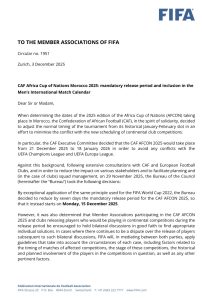
In a move that balances the demands of club football and international duty, FIFA announced on Wednesday that African stars playing for European clubs will be permitted to remain with their teams for an additional week, until December 15, before reporting to their national squads for the 2025 Africa Cup of Nations (AFCON).
This adjustment, which shortens the mandatory release period by seven days compared to the initial expectation of December 8, provides much-needed relief to top clubs navigating a congested December fixture list.
The decision mirrors the approach FIFA took ahead of the 2022 World Cup in Qatar, prioritizing a compromise that minimizes disruption during the height of the European season.
The TotalEnergies CAF Africa Cup of Nations, the 35th edition of Africa’s premier international football tournament, will unfold across Morocco from December 21, 2025, to January 18, 2026.
Hosted for the second time by the North African nation—following their 1988 edition—the event was originally slated for summer but rescheduled to avoid clashing with FIFA’s expanded 32-team Club World Cup in June-July 2025.
This marks the first AFCON to span the Christmas and New Year period, amplifying the logistical challenges for clubs reliant on African talent.
The tournament will feature 24 qualified nations divided into six groups, with matches hosted in nine stadiums across six cities, including the iconic Prince Moulay Abdellah Stadium in Rabat for the opening fixture: hosts Morocco versus Comoros on December 21 at 7:00 PM local time.
FIFA’s Bureau of the Council formalized the change following extensive negotiations involving the Confederation of African Football (CAF), European clubs, and other stakeholders. In its official statement, FIFA emphasized collaboration: “Following fruitful consultations led by Fifa with key stakeholders and thanks to the spirit of solidarity demonstrated by CAF to reduce the impact on various parties,” the governing body outlined the new timeline.
This “spirit of solidarity” acknowledges the dual pressures on players, who often form the backbone of both club success and national aspirations.
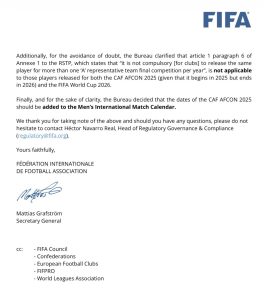
Further underscoring proactive resolution, FIFA added: “It was also decided to encourage member associations participating in the 2025 Afcon and clubs releasing players… to engage in good faith bilateral discussions in order to find appropriate individual solutions.” Where disputes arise—particularly for players involved in overlapping continental competitions like the UEFA Champions League (fixtures on December 9-10) or Europa League (December 11)—FIFA will mediate, considering factors such as match schedules, tournament stages, and a player’s expected role.
This framework aims to prevent repeats of past controversies, such as the 2024 AFCON delays faced by Manchester United’s Andre Onana, who arrived late for Cameroon’s opener due to club commitments.
Prior to this ruling, clubs braced for a December 8 cutoff, which could have sidelined key personnel for up to seven or eight English Premier League (EPL) matches amid a grueling holiday slate.
The extension ensures African players can feature in one more round of domestic action, including high-stakes derbies like the Tyne-Wear clash between Newcastle United and Sunderland on December 14.
While European clubs celebrate the breathing room, some African coaches have voiced frustration over the compressed preparation window—just six days for squads to assemble, train, and acclimate before the group stage kicks off. Mali’s Tom Saintfiet called it “catastrophic,” arguing it disrespects African football, while Comoros’ Stefano Cusin lamented disrupted logistics like canceled friendlies and booked facilities.
AFCON 2025 will deliver 52 matches of high drama, blending tactical brilliance with the continent’s renowned passion.
The group stage runs from December 21-31, followed by the knockout rounds: Round of 16 (January 3-6), quarterfinals (January 9-10), semifinals (January 14), third-place playoff (January 17), and the grand final on January 18 back in Rabat.
Defending champions Côte d’Ivoire, who staged a stunning comeback to defeat Nigeria 2-1 in the 2023 final (delayed to 2024), enter as favorites alongside powerhouses like hosts Morocco, seven-time winners Egypt, and Senegal.
The draw, conducted on January 27, 2025, in Rabat by African football legends including Mustapha Hadji and Serge Aurier, produced intriguing groups:
Venues blend Morocco’s modern infrastructure with cultural landmarks, upgraded for the event and the 2030 World Cup (co-hosted with Spain and Portugal). Highlights include:
Rabat Prince Moulay Abdellah (67,000 capacity) for opener and final; Prince Héritier Moulay El Hassan.
Casablanca: Mohammed V Stadium (45,000).
-Other hosts: Marrakech, Tangier, Agadir, Fez, and more.
CAF’s partnership with TotalEnergies ensures robust funding for development, while the official match ball, “ITRI,” draws from Moroccan zellij patterns, symbolizing unity.
The EPL, home to over 50 African players, stands to lose the most, with up to 43 potentially absent—equivalent to entire squads for some teams.
High-flying Sunderland (currently fourth) faces the heaviest blow, potentially without seven players: Ivory Coast’s Simon Adingra (best young player at AFCON 2023), Morocco’s Chemsdine Talbi, Senegal’s Habib Diarra, Mozambique’s Reinildo, Burkina Faso’s Bertrand Traoré, and DR Congo duo Arthur Masuaku and Noah Sadiki.
That’s 50 combined Premier League appearances this season, threatening their surprise Champions League push. Rock-bottom Wolverhampton Wanderers could miss five: Cameroon’s Jackson Tchatchoua, Zimbabwe’s Marshall Munetsi and Tawanda Chirewa, plus potential Nigerians Tolu Arokodare and Ivorian Emmanuel Agbadou.
Liverpool will be without Egypt forward Salah, Manchester City without his international teammate Omar Marmoush (Egypt) and Algeria’s left-back Rayan Ait-Nouri, while United will lose Cameroon’s Mbeumo, Ivory Coast winger Amad Diallo and Morocco full-back Noussair Mazraoui.
On the other hand, league leaders Arsenal, Chelsea and Leeds will be unaffected, giving them a festive edge. Nottingham Forest and Crystal Palace each risk four absences, complicating their European campaigns.
Nigeria leads representation with nine EPL players (e.g., Fulham’s Alex Iwobi, Calvin Bassey, Samuel Chukwueze; Brentford’s Frank Onyeka), followed by Ivory Coast and Senegal (six each).
Confirmed squads from Cameroon, DR Congo, and South Africa include stars like Brentford’s Bryan Mbeumo and Yoane Wissa (though Wissa’s injury may sideline him).
Elsewhere in Europe, French Ligue 1 heavyweights Paris Saint-Germain (PSG) will lose Hakimi, the reigning African Player of the Year and Morocco’s talismanic right-back, for up to five weeks— a blow despite their domestic dominance.
However, giants like Real Madrid, Barcelona, AC Milan, and Juventus face no disruptions. Bayern Munich’s Senegal forward Nicolas Jackson, on loan from Chelsea, will participate but miss few Bundesliga games thanks to the league’s winter break (December 22 to January 8).
Serie A’s Napoli could feel Andre-Frank Zambo Anguissa’s absence keenly in midfield.
Overall, the EPL could see 45 players depart, disrupting title races and relegation battles. Clubs are adapting via tactical rotations, youth promotions, or January transfers, but the “AFCON effect” remains a stark reminder of football’s global tensions.
Morocco, Egypt, Algeria, and Senegal are among the tournament favourites. Hosts Morocco, semi-finalists at the 2022 World Cup, boast home advantage and stars like Hakimi and Mazraoui; a deep run could cement their status as Africa’s elite.
Egypt, chasing an eighth title, relies on Salah’s magic amid a generational shift. Algeria’s defensive solidity and Senegal’s flair—led by Sarr and Ndiaye—promise fireworks, while Nigeria’s Super Eagles blend Premier League pedigree with Napoli’s Victor Osimhen.
Broader narratives include Côte d’Ivoire’s title defense, potential upsets from minnows like Comoros, and off-field issues like Morocco’s domestic protests over event spending amid economic woes.
CAF President Patrice Motsepe reaffirmed Morocco’s commitment in October 2025, quelling withdrawal fears.