


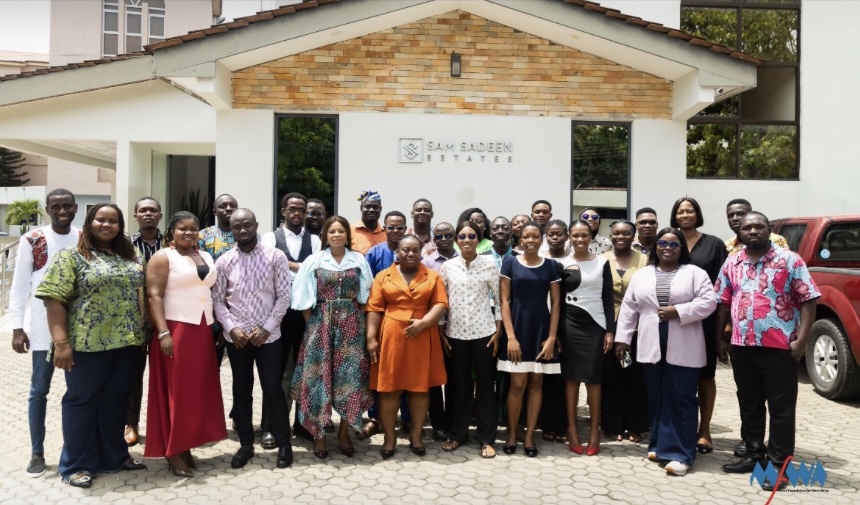
Thirty journalists from across Ghana (North, Ashanti, and Accra) sharpened their verification and financial‑analysis skills at a multi‑day training on data journalism and fact‑checking organized by the Media Foundation for West Africa (MFWA) at the Central Hotel — Ridge from Tuesday, 23 February to Thursday, 26 February 2026.
Co‑funded by the European Union, implemented by GIZ and held in cooperation with the Ministry of Finance, the programme combined practical verification tools with modules on public financial management and grant sourcing. Organizers said the training was designed to equip reporters with the skills to produce stories that advance national development and have broader impact across Africa.
“The volume and sophistication of mis‑ and dis‑information demands that journalists arm themselves with practical verification workflows,” said Roselena Ahiable, who led the fact‑checking modules. “We covered how to spot misleading claims, run reverse image and video searches, extract metadata, use geolocation basics and detect deepfakes — tools that let reporters verify visual content faster and with greater confidence.”
Hands‑on sessions guided participants through claim identification and prioritization, collecting credible evidence and following structured workflows to verify statements, images and video — skills essential for correcting false narratives in real time.
Data journalism: practical, accessible, investigative
A dedicated data‑journalism strand was led by Nii Nookwei Tackie (PhD), lecturer at the University of Media Arts and Communication — Institute of Journalism (UniMAC‑IJ). Tackie focused on making data work accessible to journalists with limited technical resources, showing how spreadsheet tools can underpin rigorous reporting.
“Excel remains the most accessible entry point for the majority of newsrooms,” Tackie said. “We walked participants through data cleaning, basic formulas, pivot tables, and joins — techniques you can use to reconcile procurement records, compare budget lines or spot anomalies in payment flows. Even simple visualisations and filters can reveal patterns that prompt deeper investigation.”
Tackie demonstrated workflows using public budget and procurement samples, teaching participants how to import CSV files, remove duplicates, handle missing values, and use conditional formatting to flag outliers. He also introduced lightweight open‑source tools and strategies for moving from spreadsheets to more advanced analysis when needed.
“When a dataset looks messy, reporters should know how to get it into a usable shape and how to ask the right questions of the numbers,” Tackie added. “Data skills aren’t about replacing reporting; they amplify interviews, documents and records so journalists can follow the money with evidence.”
Financial accountability and grants
A second strand of the training focused on public financial accountability. Nana Kwaku Amankwah Appiah walked participants through balance sheets, income statements and cash‑flow statements, showing how routine accounting documents can reveal opacity or red flags in procurement and spending.
“Reading financial statements isn’t abstract; it’s how you follow the money,” Nana Kwaku said. “We examined Act 921 and the constitutional provisions governing public funds, and highlighted the institutional roles of Parliament and the Auditor‑General. Once you can spot anomalies in procurement or inconsistencies across statements, investigative leads open up.”
The training used case studies to demonstrate common pitfalls and signs of mismanagement, giving reporters a sharper investigative lens for tracing public resources.
The programme also addressed sustainability of investigative work. Senanu Tord of Voice of America led sessions on sourcing grants and writing proposals, offering practical guidance on identifying funding opportunities and managing grants responsibly.
“Strong stories need sustained resources,” Senanu said. “Knowing how to structure proposals, budget realistically and manage donor expectations turns reporting ideas into fundable projects without compromising editorial integrity.”
Organizers and participant perspectives
An MFWA spokesperson said the combination of technical verification and public‑finance expertise was deliberate. “Data skills and financial literacy are two sides of the same accountability coin,” the spokesperson said. “When journalists can verify visual claims and also follow budgets, they are better positioned to produce impactful journalism that serves the public good.”
I attended the training and found the mix of practical tools and legal‑institutional context particularly valuable. The fact‑checking modules gave me concrete methods — reverse image search, metadata extraction and geolocation — that I can apply immediately. The sessions on Act 921 and the roles of oversight institutions clarified where to look when following the money. The proposal‑writing module also answered a pressing need: how to translate investigative ambitions into sustainable, funded projects.
Participants said they plan to apply the verification techniques and financial‑analysis methods in upcoming investigations, share learned practices with their newsrooms and pursue grant opportunities to support deeper reporting.
As misinformation grows and public scrutiny of spending intensifies, trainers say empowering reporters with data‑driven verification skills and financial literacy is essential to strengthening accountability and producing journalism that has real impact on citizens’ lives.
By Felix Kwetey


