


The 2026 Women’s Africa Cup of Nations, commonly known as WAFCON, represents a landmark event in African women’s football, set to unfold in the vibrant host nation of Morocco from March 17 to April 3.
This marks the first time the tournament expands to include 16 participating teams in the group stage format. The expansion underscores the growing investment and interest in women’s soccer across the continent, building on the legacy of previous editions that have showcased emerging talents and fierce rivalries while serving as a crucial qualifier for the FIFA Women’s World Cup, with the top four finishers earning spots in the 2027 global showcase.
Morocco, as the host, benefits from automatic qualification and the advantage of playing on home soil in iconic venues across cities like Rabat, Casablanca, and Fez. The passionate local crowds are expected to create an electric atmosphere that could propel their team deep into the competition.
The final draw for the groups, conducted in Rabat on January 15, 2026, has set the stage for what promises to be a thrilling tournament, dividing the qualified nations into four balanced groups that blend established powerhouses with ambitious underdogs, each vying for advancement to the knockout rounds where the top two from each group will progress.

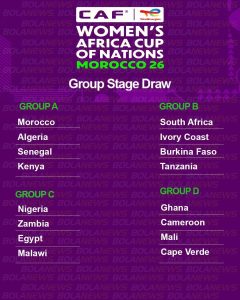
At the heart of the discussion lies Group D, a compelling quartet featuring Ghana, Cameroon, Mali, and Cape Verde. This group stands out for its mix of historical pedigree, recent resurgence, and debutant energy that could lead to unpredictable outcomes and high-stakes matches.
Ghana, often referred to as the Black Queens, enters the fray as the group’s seeded team and a perennial contender in African women’s football. They boast a rich history that includes multiple semifinal appearances and a runner-up finish in the 2000 WAFCON, though they have yet to claim the ultimate title despite their consistent presence in the competition since its inception in 1991.
Their qualification for this edition came through a hard-fought campaign, highlighted by dominant performances against regional rivals. Under the guidance of experienced coaches who emphasize tactical discipline and attacking flair, Ghana’s squad is built around a core of players plying their trade in top European leagues, such as forwards like Evelyn Badu and midfield maestros who bring creativity and resilience to the pitch.
This group placement offers Ghana a golden opportunity to leverage their experience against familiar foes, potentially topping the standings if they can harness their speed on the counter and solid defensive organization, which has been a hallmark in recent internationals.
Sharing the group with Ghana is Cameroon, the Indomitable Lionesses, whose storied rivalry with their West African neighbors adds an extra layer of intrigue to the proceedings. These two nations have clashed in memorable encounters over the years, including knockout stage battles that have defined past tournaments.
Cameroon, with three runner-up finishes in WAFCON history (most recently in 2016) and a reputation for producing world-class talents like Nchout Njoya Ajara, who has dazzled on global stages including the Olympics and World Cup, qualified impressively by overcoming stiff competition in the preliminaries.
They showcase a blend of physicality, technical skill, and never-say-die spirit that makes them a threat to any opponent. Their approach often revolves around a high-pressing game and quick transitions, which could exploit any lapses in Ghana’s backline.
With a new generation of players emerging from domestic leagues bolstered by diaspora stars, Cameroon aims not just to advance from the group but to challenge for the trophy, drawing on their experience from multiple World Cup appearances to handle the pressure of a tournament hosted in North Africa.
Mali brings its own dynamic energy to Group D, representing a team on the rise in women’s African football after securing qualification through gritty performances that highlighted their defensive solidity and opportunistic scoring.
This marks their return to the WAFCON finals after sporadic appearances in previous editions. Known as the Eagles, Mali’s women’s team has been investing heavily in youth development programs, resulting in a squad that combines raw athleticism with tactical awareness, often relying on set-piece prowess and midfield battles to grind out results against stronger sides.
While they may lack the star power of Ghana or Cameroon, Mali’s underdog status could work in their favor, allowing them to play with freedom and potentially spring surprises, especially if key players like forward Bassira Touré, who has been prolific in regional competitions, can find form early in the tournament and capitalize on counterattacks against more possession-oriented teams.
Rounding out Group D is Cape Verde, the debutants whose inclusion in the 2026 WAFCON symbolizes the broadening horizons of women’s football in Africa. They make their historic first appearance at this level after a remarkable qualification run that saw them upset more established nations through sheer determination and organized play.
As an island nation with a growing football infrastructure, Cape Verde’s team, often called the Tubarões Azuis or Blue Sharks in reference to their men’s counterpart, draws inspiration from their rapid ascent in international rankings.
Fueled by a diaspora of players competing in Portugal and other European countries, they bring professionalism and skill to a squad that emphasizes teamwork over individual brilliance.
Their entry into the tournament not only highlights CAF’s efforts to include more nations but also adds an element of novelty to Group D, where Cape Verde could play the role of spoiler, using their unfamiliarity to opponents’ advantage in matches that might see them adopt a compact, defensive strategy to frustrate the favorites and snatch points through disciplined efforts.
Beyond the specifics of Group D, the broader tournament landscape is equally captivating. Group A pits hosts Morocco against Algeria, Senegal, and Kenya in what could be a North African-dominated affair tempered by East and West African flair.
Morocco, fresh off strong showings in recent global events including a historic run to the knockout stages of the 2023 Women’s World Cup, will look to dominate at home with their technically gifted squad led by stars like Ghizlane Chebbak, while Algeria and Senegal bring defensive resilience and Kenya adds pace from their emerging talents.
Group B features defending champions South Africa, the Banyana Banyana, who triumphed in 2022 and enter as favorites with a potent attack spearheaded by Thembi Kgatlana, facing off against Ivory Coast, Burkina Faso, and Tanzania in a group that promises goals and drama. Group C emerges as the proverbial “group of death,” headlined by perennial powerhouses Nigeria, the Super Falcons with a record 11 titles, alongside Zambia, who stunned the world at the Olympics, Egypt’s resurgent Pharaohs, and Malawi, setting up clashes that could rival finals in intensity and quality.
As the tournament approaches in just over two months, anticipation builds around not only the on-field action but also the off-field impacts, such as boosting women’s sports infrastructure in Morocco and inspiring a new generation of female athletes across Africa through increased visibility and media coverage.
The format ensures a packed schedule of group stage matches leading into quarterfinals, semifinals, and the grand final on April 3, likely in Rabat’s Stade Olympique, where the champions will lift the trophy amid celebrations that echo the continent’s passion for the beautiful game.
For Ghana and their Group D compatriots, the path to glory begins with navigating this challenging pool, where every match could hinge on moments of brilliance, tactical nous, or sheer willpower, ultimately contributing to what is poised to be one of the most competitive WAFCON editions yet.


